


 Charles
LEMOINE (LEMOYNE)
Charles
LEMOINE (LEMOYNE)
(b.
2 August 1626
,
Dieppe, France
d.
30 January 1685
,
Montréal, Canada, New France
)
Am I Your Ancestor?
LEMOINE (LEMOYNE) Family Tree – Connecting the Past to the Present!
Charles LEMOINE (LEMOYNE) was born 2 August 1626 in Dieppe, France
Charles LEMOINE (LEMOYNE) was the child of Pierre LEMOINE (LEMOYNE) and Judith DUCHESNECharles was an immigrant to Canada, arriving by 1641.
Spouse(s)/Partner(s) and Child(ren):
Charles married Catherine THIERRY dite PRIMOT 28 May 1654 in Montréal, Canada, New France . The couple had (at least) 5 children.
Catherine THIERRY dite PRIMOT was born abt. 1626 in Rouen, France. Catherine died 5 August 1690 in Montréal, Québec, Canada (Sault-au-Récollet) (Côte-St-Michel) (Côte-St-Paul).
Charles LEMOINE (LEMOYNE) died 30 January 1685 in Montréal, Canada, New France .
Details of the family tree of Charles appear below.
Occupation
Charles LEMOINE (LEMOYNE) was a - Soldier, interpreter, fur trader, merchant, seigneur.
A marchand, or merchant, was a trader who sold a specific type of merchandise or product. Merchants handled most of the supply and distribution of products that came from Europe.
Source: tfcq.ca
Charles LEMOINE (LEMOYNE) was a - Soldier, interpreter, fur trader, merchant, seigneur.
A marchand, or merchant, was a trader who sold a specific type of merchandise or product. Merchants handled most of the supply and distribution of products that came from Europe.
Source: tfcq.ca
 Québec Généalogie - Over time, Québec has gone through a series of name changes
From its inception in the early 1600s until 1760, it was called Canada, New France.
1760 to 1763, it was simply Canada
1763 to 1791 - Province of Québec
1791 to 1867 - Lower Canada
1867 to present - Québec, Canada.
Thanks to Micheline Gadbois MacDonald for providing this information.
Québec Généalogie - The Seigneurial System (1627 - 1854)The seigneurial system was a form of land settlement modeled on the French feudal system. It began in New France in 1627 with the formation of the Compagnie des Cent-Associés (or Company of 100 Associates), which was initially responsible for handing out land grants and seigneurial rights. The land was divided into five by 15 kilometer plots, usually along major rivers like the St. Lawrence. They were then further subdivided into narrow, but long lots for settlement. These lots were usually long enough to be suitable for faming, and they provided everyone who lived on them with equal access to neighbouring farms and the river. There were three main groups of people who lived off the land in this system: Seigneurs, Habitants and Engagés
Charles LEMOINE (LEMOYNE) was a seigneur.
Seigneurs were the most important colonists, as they were usually in the military or aristocracy prior to being a settler. These seigneurs then were charged with the task of subdividing large parcels of land into five by 15 kilometer concessions, then renting this land to a habitant. Under regulations set up by the French government in France, the seigneur could also set up a court of law, set up a mill on his land and organize a commune.
Source: Canada in the Making (www.canadiana.ca/citm/index_e.html)
Family and Children of Charles LEMOINE (LEMOYNE)
[Hide/Show]Charles LEMOINE (LEMOYNE) married 
 Catherine THIERRY dite PRIMOT-- Date: 28 May 1654 Place: Montréal, Canada, New France
www.oocities.org/ weallcamefromsomewhere/ Kebec/ catherine_thierry.html
Charles Lemoyne - Was born on December 10, 1656 and died on June 07, 1729 in Montreal. He married Claude-Elisabeth Souart and the couple had eight children. She died on September 15, 1724 and Charles would then marry Marguerite Legardeur.
Jacques Lemoyne - Was born on April 16, 1659 and died on December 03, 1690 in Montreal. He married Jeanne Caron and the couple had three children.
Pierre Lemoyne - Was born on July 20, 1661 in Montreal and died on July 09, 1706 in San Cristobel, Havanna, Cuba. He married Marie-Therese Pollet and the couple had five children.
Paul Lemoyne - Was born on December 15, 1663 and died on March 21, 1704. He married Marie-Madeleine Dupont and Gabrielle-Francoise Aubert.
Francois Lemoyne - Was born on March 10, 1665 in Montreal and died on June 07, 1691; shot in an encounter with a group of Onneyouts at Repentigny.
Joseph Lemoyne - Was born on July 22, 1668 in Montreal. He returned to France where he became the Governor of Rochefort, dying there on September 12, 1734. He married Marie-Elisabeth Heron and the couple had two children.
Francoise-Marie Lemoyne - Was born on September 22, 1670 and died on September 21, 1687 in Montreal.
Infant Lemoyne - Was born on October 02, 1672 and died the same day in Montreal.
Catherine-Jeanne Lemoyne - Was born on November 15, 1675 in Montreal and died unknown. She married Pierre-Jacques Payan and the couple hafd five children.
Louis Lemoyne - Was born on January 04, 1676 in Montreal and died on October 04, 1694; killed in Battle with the English at Fort Nelson, Hudson Bay.
Marie-Anne Lemoyne - Was born on August 13, 1678 and died unknown in Montreal. She married Jean-Baptiste Boulet.
Jean-Baptiste Lemoyne - Was born on February 23, 1679 in Montreal and died on March 07, 1767 in Paris, France.
Gabriel Lemoyne - Was born on November 13, 1681 and died on November 24, 1701 in Montreal.
Antoine Lemoyne - Was born on July 07, 1683 in Montreal and died on March 24, 1752 in Rochefort, France.
Children of Charles LEMOINE (LEMOYNE) and Catherine THIERRY dite PRIMOT:


 Charles LEMOINE (LEMOYNE) (b.10 December 1656, Montréal, Canada, New France d. 7 June 1729, Montréal, Canada, New France )
m. Claude-Elisabeth SOUART 7 May 1681 in Paris, France
m. Marguerite LEGARDEUR 17 September 1737 in Longueuil, Québec, Canada (Saint-Antoine-de-Longueuil)
Jacques LEMOINE (LEMOYNE) (b.16 April 1659, Montréal, Canada, New France d. 3 December 1690, Montréal, Canada, New France )
m. Jeanne DECARION 7 February 1684 in Montréal, Québec, Canada (Sault-au-Récollet) (Côte-St-Michel) (Côte-St-Paul)
Pierre LEMOINE (LEMOYNE) (b.20 July 1661, Montréal, Canada, New France d. 9 July 1706, , Cuba)
Paul LEMOINE (LEMOYNE) (b.15 December 1663, Montréal, Canada, New France d. 21 March 1704, Montréal, Canada, New France )
Joseph LEMOINE (LEMOYNE) (b.22 July 1668, Montréal, Canada, New France d. 12 September 1734, , France)
Catherine THIERRY dite PRIMOT-- Date: 28 May 1654 Place: Montréal, Canada, New France www.oocities.org/ weallcamefromsomewhere/ Kebec/ catherine_thierry.html
Charles Lemoyne - Was born on December 10, 1656 and died on June 07, 1729 in Montreal. He married Claude-Elisabeth Souart and the couple had eight children. She died on September 15, 1724 and Charles would then marry Marguerite Legardeur.
Jacques Lemoyne - Was born on April 16, 1659 and died on December 03, 1690 in Montreal. He married Jeanne Caron and the couple had three children.
Pierre Lemoyne - Was born on July 20, 1661 in Montreal and died on July 09, 1706 in San Cristobel, Havanna, Cuba. He married Marie-Therese Pollet and the couple had five children.
Paul Lemoyne - Was born on December 15, 1663 and died on March 21, 1704. He married Marie-Madeleine Dupont and Gabrielle-Francoise Aubert.
Francois Lemoyne - Was born on March 10, 1665 in Montreal and died on June 07, 1691; shot in an encounter with a group of Onneyouts at Repentigny.
Joseph Lemoyne - Was born on July 22, 1668 in Montreal. He returned to France where he became the Governor of Rochefort, dying there on September 12, 1734. He married Marie-Elisabeth Heron and the couple had two children.
Francoise-Marie Lemoyne - Was born on September 22, 1670 and died on September 21, 1687 in Montreal.
Infant Lemoyne - Was born on October 02, 1672 and died the same day in Montreal.
Catherine-Jeanne Lemoyne - Was born on November 15, 1675 in Montreal and died unknown. She married Pierre-Jacques Payan and the couple hafd five children.
Louis Lemoyne - Was born on January 04, 1676 in Montreal and died on October 04, 1694; killed in Battle with the English at Fort Nelson, Hudson Bay.
Marie-Anne Lemoyne - Was born on August 13, 1678 and died unknown in Montreal. She married Jean-Baptiste Boulet.
Jean-Baptiste Lemoyne - Was born on February 23, 1679 in Montreal and died on March 07, 1767 in Paris, France.
Gabriel Lemoyne - Was born on November 13, 1681 and died on November 24, 1701 in Montreal.
Antoine Lemoyne - Was born on July 07, 1683 in Montreal and died on March 24, 1752 in Rochefort, France.
Children of Charles LEMOINE (LEMOYNE) and Catherine THIERRY dite PRIMOT:
Charles LEMOINE (LEMOYNE) (b.10 December 1656, Montréal, Canada, New France d. 7 June 1729, Montréal, Canada, New France )m. Claude-Elisabeth SOUART 7 May 1681 in Paris, France
m. Marguerite LEGARDEUR 17 September 1737 in Longueuil, Québec, Canada (Saint-Antoine-de-Longueuil)
Jacques LEMOINE (LEMOYNE) (b.16 April 1659, Montréal, Canada, New France d. 3 December 1690, Montréal, Canada, New France )m. Jeanne DECARION 7 February 1684 in Montréal, Québec, Canada (Sault-au-Récollet) (Côte-St-Michel) (Côte-St-Paul)
Pierre LEMOINE (LEMOYNE) (b.20 July 1661, Montréal, Canada, New France d. 9 July 1706, , Cuba) Paul LEMOINE (LEMOYNE) (b.15 December 1663, Montréal, Canada, New France d. 21 March 1704, Montréal, Canada, New France ) Joseph LEMOINE (LEMOYNE) (b.22 July 1668, Montréal, Canada, New France d. 12 September 1734, , France) Share the History, Life Events, and Stories of Charles LEMOINE (LEMOYNE)
(Add details like birth, baptism, census records, military service, obituary, personal achievements, and more.)
[Hide/Show]
Discovering the Ancestry of Charles LEMOINE (LEMOYNE): Events, Photos & Historical Records
 1626 Birth
 2 August 1626
Dieppe, France
Biography
LE MOYNE DE LONGUEUIL ET DE CHÂTEAUGUAY, CHARLES, soldier, interpreter, trader, seigneur, son of Pierre Le Moyne, innkeeper, and of Judith Du Chesne; b. 2 Aug. 1626 at Dieppe (Normandy); d. February 1685 at Montreal.
The fact that his maternal uncle, the surgeon Adrien Du Chesne, was in the colony, encouraged Charles Le Moyne to come to New France. He was 15 years old when he arrived in 1641. At first he was an indentured employee of the Jesuits in the Huron country, and over a period of four years he familiarized himself with the Indian languages.
In 1645 he was serving in the Trois-Rivières garrison as an interpreter, a clerk, and a soldier. The following year he settled at Ville-Marie (Montreal), where he was to remain throughout his whole career. His life there took the form of continual skirmishes with the Indians, who plagued the fort unceasingly with their attacks. In 1646, and again in 1648, he took a number of Iroquois prisoners. In the spring of 1651, with the pioneer...Read MORE...
Dictionary of Canadian Biography (www.biographi.ca)
LE MOYNE DE LONGUEUIL ET DE CHÂTEAUGUAY, CHARLES, soldier, interpreter, trader, seigneur, son of Pierre Le Moyne, innkeeper, and of Judith Du Chesne; b. 2 Aug. 1626 at Dieppe (Normandy); d. February 1685 at Montreal.
The fact that his maternal uncle, the surgeon Adrien Du Chesne, was in the colony, encouraged Charles Le Moyne to come to New France. He was 15 years old when he arrived in 1641. At first he was an indentured employee of the Jesuits in the Huron country, and over a period of four years he familiarized himself with the Indian languages.
In 1645 he was serving in the Trois-Rivières garrison as an interpreter, a clerk, and a soldier. The following year he settled at Ville-Marie (Montreal), where he was to remain throughout his whole career. His life there took the form of continual skirmishes with the Indians, who plagued the fort unceasingly with their attacks. In 1646, and again in 1648, he took a number of Iroquois prisoners. In the spring of 1651, with the pioneer...Read MORE...
Dictionary of Canadian Biography (www.biographi.ca)
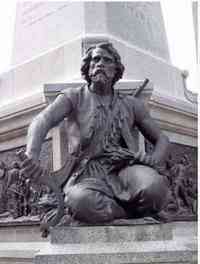
 - )
commons.wikimedia.org/ wiki/ File:Charles_Le_Moyne_Monument_Maisonneuve.jpg
1653 - Seigniory of Longueuil was first granted in 1653 to Charles LeMoyne, Sieur de Longueuil.
Visit Longueuil, Québec, Canada (Saint-Antoine-de-Longueuil)
rootsweb.ancestry.com
Visit Longueuil, Québec, Canada (Saint-Antoine-de-Longueuil)
rootsweb.ancestry.com
 1654 Marriage / Partner
Charles LEMOINE (LEMOYNE) and Catherine THIERRY dite PRIMOT 28 May 1654, Montréal, Québec, Canada (Sault-au-Récollet) (Côte-St-Michel) (Côte-St-Paul)
He was 27 years old.
 1656 Birth of Child
Charles LEMOINE (LEMOYNE) was born 10 December 1656, Montréal, Québec, Canada (Sault-au-Récollet) (Côte-St-Michel) (Côte-St-Paul)
Charles was 30 years old.
1659 Birth of ChildJacques LEMOINE (LEMOYNE) was born 16 April 1659, Montréal, Québec, Canada (Sault-au-Récollet) (Côte-St-Michel) (Côte-St-Paul)
Charles was 32 years old.
1661 Birth of ChildPierre LEMOINE (LEMOYNE) was born 20 July 1661, Montréal, Québec, Canada (Sault-au-Récollet) (Côte-St-Michel) (Côte-St-Paul)
Charles was 34 years old.
1663 Birth of ChildPaul LEMOINE (LEMOYNE) was born 15 December 1663, Montréal, Québec, Canada (Sault-au-Récollet) (Côte-St-Michel) (Côte-St-Paul)
Charles was 37 years old.
1668 Birth of ChildJoseph LEMOINE (LEMOYNE) was born 22 July 1668, Montréal, Québec, Canada (Sault-au-Récollet) (Côte-St-Michel) (Côte-St-Paul)
Charles was 42 years old.
1681 Marriage of ChildCharles LEMOINE (LEMOYNE) married 7 May 1681, Paris, France to Claude-Elisabeth SOUART
1684 Marriage of ChildJacques LEMOINE (LEMOYNE) married 7 February 1684, Montréal, Québec, Canada (Sault-au-Récollet) (Côte-St-Michel) (Côte-St-Paul) to Jeanne DECARION
 1685 Death
 30 January 1685
Montréal, Canada, New France
He died at the age of 58.
Added: 1/16/2015 10:48:31 AM
- Updated: 12/6/2023 4:35:16 PM


Not the person you are looking for? Try again!
Search for YOUR Family by Name
NOTE: If you don't know your ancestor's whole name or are unsure of the spelling, specify part of the name.Search for YOUR Family by Place
Genealogy research for Charles Lemoine (Lemoyne) (on other sites)

Find out more about Charles LEMOINE (LEMOYNE).
Sign In or
Join for FREE! to see the details!
Completely FREE. We will never ask for your credit card or personal information.

