
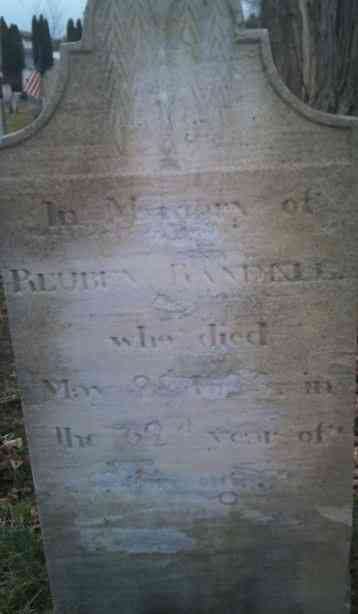
Reuben RANDALL
1826 Partition Complaint
(National Advocate, Nov 9, 1826) — the original partition complaint
This is the earlier notice, filed at a court of equity for the fourth circuit at Saratoga Springs, August 20, 1826, before Circuit Judge Reuben H. Walworth. It gives you the crucial genealogical nugget:
"...complaint in this cause, setting forth, among other things, that Mary Mosher, late of the town of Saratoga, widow of David Mosher, died on the thirty-first day of May in the year of our Lord eighteen hundred and thirteen, seized in fee simple, of, in and to the following described premises, situate, lying, and being in the town of Saratoga Springs, formerly Saratoga, to wit: All that farm bounded on the north and east by lands of Sarah Stafford, on the south by Fish Creek and the lands of Benjamin Avery, and on the west by the lands of Miles Beach and John Tice, said to contain one hundred and thirty acres."
The complaint goes on to say that this land descended to Mary Mosher's heirs and devisees, that some heirs have since conveyed or divided their shares, while others hold undivided interests, and that the ownership and interests of some parties are unknown — hence the need for a court-ordered partition. The case names, among the parties, William W. Welch, David Mosher, Benjamin Mosher, David Fish, and Reuben Randall — the same lineup as in the 1828 notice.
Why this matters for your Mosher research
This is a direct, dated confirmation of Mary Mosher's death: May 31, 1813, as widow of David Mosher, in the town of Saratoga (Saratoga Springs). This is the mother of George, Deborah, Elizabeth, Nancy, David, and Benjamin Mosher in your tree — you now have a specific death date to add to her record, sourced to a Chancery Court partition filing.
It also shows that after Mary's death in 1813, her 130-acre farm (bounded by Fish Creek, Sarah Stafford's land, Benjamin Avery's land, and lands of Miles Beach and John Tice) passed to her heirs, but the division wasn't cleanly resolved — some shares were sold or conveyed, others remained undivided, and by the mid-1820s outside parties (Valentine and Vail) were suing to force a partition, presumably because they'd acquired an interest in one or more of the unresolved shares.
This partition dispute is very likely the direct backstory to the 1817 Welch mortgages you found earlier — the Mosher children (George, Benjamin), in-laws (Cummins Salisbury, Reuben Randall), and David Fish jointly purchasing land from Welch in 1817 may well be connected to, or overlapping with, this same family land that had been in limbo since Mary Mosher's 1813 death. It's possible the 1817 transaction was part of an attempt to formalize or buy out shares in the same general tract, and the partition suit a decade later was cleaning up what remained unresolved.
THE NATIONAL ADVOCATE. Thursday, Nov 09, 1826 New York, NY Vol: XIV Issue: 4011 Page: 4

Learn more about the life of


 Reuben RANDALL.
Visit Stonington, Connecticut, USA (Pawcatuck) (Lords Point)
Discover the people who lived there, the places they visited and the stories they shared.