
Benjamin Albee CORBIN
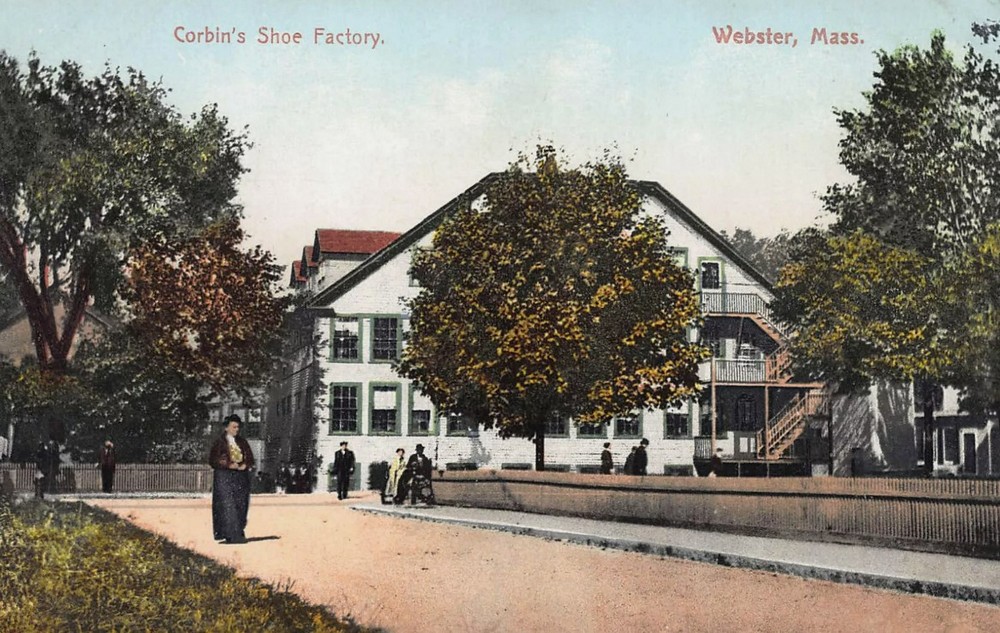
B.A. Corbin Shoe Factory, circa 1900.
Benjamin Albee Corbin was born in Dudley in June 1809. His younger brother, Lament Bacon Corbin, came along in 1813. They were born into a large and poor family. Timothy Corbin Jr., their father, had died in 1825 at age 45 leaving a wife and nine young children. By the mid 1830’s, the two boys were making shoes in a shop behind their house near Dudley Hill.
Benjamin married Louisa Brown in 1835. His brother, Lament (often misspelled as Lamont) married Melezenda Pierrepont in 1841 and relocated his part of the shoe business to Oxford (he died in Oxford in 1872 of “fitts”).
In 1849, Ben bought a piece of land from Moses Barnes, 65-1/ 2 rods in size (almost half acre), that sat just to the south of the little yellow house now called the Penniman house on Dudley Hill. Ben continued as a cordwainer and the business prospered. He began looking for a new place for his business and decided the lot on the corner at Dudley Hill’s “four corners” would be ideal. However, as the saying goes, “there is one in every crowd,” and the then neighbor directly across the street on the opposite corner, Colonel John Hancock, objected to Corbin’s plans, citing the noise that would be created. Benjamin did not put his business here.
On April 2, 1852, Benjamin sold the 65 1/ 2 rods property to Dolly Leavens for $1,000. Unperturbed about his Dudley plans falling through, on April 11, 1853, Benjamin bought a home on Main Street near the Congregational Church in Webster from Congregational minister Lorenzo Cary for $2,600. A workshop was built behind the building for making shoes. B.A. Corbin Shoe Manufacturing had moved to Webster.
In 1853, its first year, 140-160 shoe operatives made probably $200,000 worth of shoes. Ben dropped his two partners in 1854 and production increased to $300,000 yearly. Production peaked at about $450,000 with 300 operatives employed in the plant. In 1862 he took his son, Chester C. Corbin, into the firm, which became B. A. Corbin & Son.
In need of ever more space, in 1863 Ben bought land of the Negus heirs, just under one acre, behind his place on Main Street as well as other small parcels Eventually the factory went from Main Street through to Negus Street. Corbin Shoe became a major employer in Webster.
Benjamin Corbin had been feeling poorly in October 1880, but on the 15th the 71-year-old shoemaker and businessman had been feeling well enough to partake of his favorite recreation— fishing. Ben had the reins and was driving back to town at the end of the day when at about the corner of Negus Street he suddenly handed the reins to Mr. Albert Champagne (driver/ employee), who seeing all was not right with Mr. Corbin drove him as fast as possible to his home, where a physician was called. Mr. Corbin was dead by the time the doctor got there.
This humble and courteous man’s passing evoked genuine sorrow among his employees, who attended the funeral in a group. Flowers were many and unique: There was an arrangement in the form of a shoe, one in the form of a hammer, and one in the form of a broken column. Following the ceremony, it took an hour for the mourners to file past the casket to pay last respects. Burial was in his hometown of Dudley. His son now took over.
In 1911 following a shoe workers’ strike earlier in 1898 that had damaged the operation of the S. Herbert Shoe manufactory in Marlboro, B A. Corbin & Son bought the company and continued the production of shoes there as well.
From 1914-1918 during World War I, Corbin Shoe was totally involved in manufacturing for the U.S. government and its allies, making more shoes than any other manufacturer.
By 1930 Corbin Shoe had become the longest operating shoe company in the United States. There were literally generations of families in Webster and environs who had been employed at Corbin Shoe. But the stock market crash of 1929 was to leave its mark.
On Jan. 11, 1933, The Webster Times carried the headline that the Corbin plant in Webster was closing within three weeks, at the end of the current run. About 175 operatives still employed (half the usual number) would be losing their jobs. E. Guy Howard, then superintendent of the factory, declared the company could no longer run at a loss; one of the Marlboro plants had already closed; all work was to be done in the remaining Marlboro plant owned by Corbin.
Despite efforts of Webster selectman chairman Joseph Patenaude to keep the firm from closing, manufacturing at the Webster plant ceased and the building was left abandoned with much of the machinery being left behind (an entity called Webster Shoe eventually took over the Webster buildings).
The year 1971 saw the demise of what was left of Benjamin A. Corbin’s company. The original B.A. Corbin & Son on Main Street in Webster is no longer standing. The Corbin shop in Marlboro continued to function until 1971; it now has been converted into condominiums, all but one of which is occupied. In Webster, The Midtown Deli on Main Street sits where the Benjamin Corbin home had been since 1854 and the parking lots behind it, as seen from Google Earth, show the footprint of the old factory going all the way to Negus Street.
And it all had started in a little shoe shop in Dudley.
L.K. Branniff is on the Board of Directors at the Black Tavern Historical Society in Dudley. She volunteers a historical column each month to the Webster Times.

Learn more about the life of

 Benjamin Albee CORBIN.
Visit Dudley, Massachusetts, USA
Discover the people who lived there, the places they visited and the stories they shared.