
Henry LUNT
Biography
"Henry Lunt and his wife, Ann, immigrated to America from London, Middlesex, England on 22 March 1633, on the ship Mary and John.
The ship first landed in Agawam (now Ipswich), Massachusetts in 1633. Some of the passengers remained in Agawam, while the Lunts joined a group who had decided to settle in Newberry Plantation (subsequently renamed Newbury) in 1634-35.
The trek from Ipswich to Newberry Plantation was not simple. There were no roads; the wilderness was trackless. Tradition has it that the settler families and all their household goods arrived via the Plum Island Sound in May or June of 1635, landing on the north shore of the Parker River. And so Henry and Ann Lunt and their fellow colonists began plowing, planting, building sheds and houses, and laying out and granting meadow lots for grazing.
Newbury began its existence as a joint stock-raising enterprise; its cattle imports arrived from Holland with the second wave of inhabitants. The first supply of Dutch cattle came with a man hired by the stockholders to feed and care for the livestock of the settlers. The employee, Thomas Coleman, quit shortly after arriving; however, the decision was made that the care of the livestock would thenceforward be assigned to the individual owners. This added considerably to the burdens of the individual settlers, but the settlement soon flourished.
The town's growth and prosperity were not accomplished without travail, both political and natural. In 1646, there was a sudden and hugely damaging plague, a "strong hand of God" upon all the English plantations, of "inneumerable armies of caterpillars," resulting in enormous loss of hay, corn, and barley crops. The town responded with prayer and fasting; the invasion ceased as suddenly as it began.
Prayer and fasting were less successful with some of the other difficulties arising in small communities. In 1654 Henry Lunt was one of the many inhabitants of Newbury and other towns who signed a petition in support of Lieutenant Robert Pike, who had earlier been censured by the General Court for remarks defamatory of the government. At issue was Lieutenant Robert Pike's public declaration that the law prohibiting preaching on the part of people who hadn't been officially sanctioned by the court was "against the liberty of the country, both civil and ecclesiastical." The court declared him guilty of defamation...
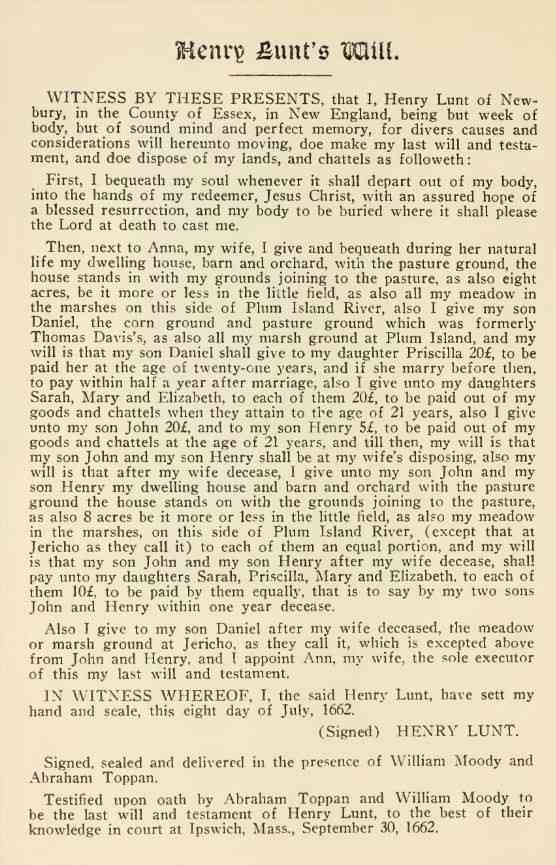
Henry Lunt, like most of the rest of his cohort, succeeded in building a good life for his family and providing a good head start for his descendants. He left a large property for his wife and seven children his will was executed in Newbury on 8 July 1662..."
The Story of an American Family: The Lunt Family from 1633 to the Present
By Lynda Zwinger, PhD
)
Learn more about the life of


 Henry LUNT.